
August 2025
Seeing the picture in the noise.

Preliminaries
This is the first post in a series that will provide a monthly collection of climate and energy-related web links collected by me this month, but not necessarily always from this month. I wrote some explanation and clarification if found necessary or interesting. We have now October, so the post is a bit late, but I decided to start with August anyway.
The aim is to provide a synoptic overview of the flood of daily news reports so that developments and trends can be identified. It can also be used as a collection of bookmarks – you remember seeing something here and can find it again more easily.
As the field is so vast, it can hardly be covered by a single “digest”. So this is - and has to be - a somewhat arbitrary selection of information.
Some of the linked web pages will be non-english, e.g. in German, and centered on EU or German topics - if interested, use the brwoser web translation tools.
The articles are sorted into four sections, of which the last one is the smallest:
Renewables, Storage and similar
General Account
A central topic is the acceleration of global warming, as represented by a couple of findings. The exact degree of acceleration is not clear, but it is considerable. This is not a complete overview of all scientific opinions about the topic! The upcoming cycle of earth system models, which will have better representation of crucial data, will hopefully bring more clarity.
Sea level rise is just reflecting this acceleration.
An important component is the decreasingCO₂-absorption capacity of the worlds forests, with a couple of links supporting this finding.
On the technology side, news are generally good. I did not go into PV and battery price curves here - maybe somewhat later. But not all is going smoothly: we have the China-dominance problem, permitting problems, rebound effects.
In Politics, we see some backlashes, like with the failed plastics agreement and and reduced financing for emerging countries to get off of coal, but there are also good news: China going ahed with emissions regulations, and the the growing anchoring and support of climate protection in the justice system.
The Earth System
Global Warming Accelerated
A couple of scientists, with James Hansen as an important protagonist, claim, that the earth system without human emitted aerosols shows a much heftier GHG response than supposed until now. In other words: its climate sensitivity is more on the high side, more around +5 K instead of the generally assumed +3 K. In this substack post with a lot of links to other papers, he lays out the general arguments for this. (Unfortunately, he harbours a mild form of conspiracy theory against other climate scientists who question this approach and would use ad-hominem attacks on him.)
In this paper, published on his Columbia Uni web space, and in this recommendable Youtube-podcast, he gives his main arguments in more detail:
Chemical proxies show that the temperature jump from interglacial periods to ice ages was significantly greater than the foraminifera proxies indicate. This means, that the ratio of it to the respective CO2-concentration jump, from which we can calculate a paleoclimatic climate sensitivity of the earth system, was bigger too.
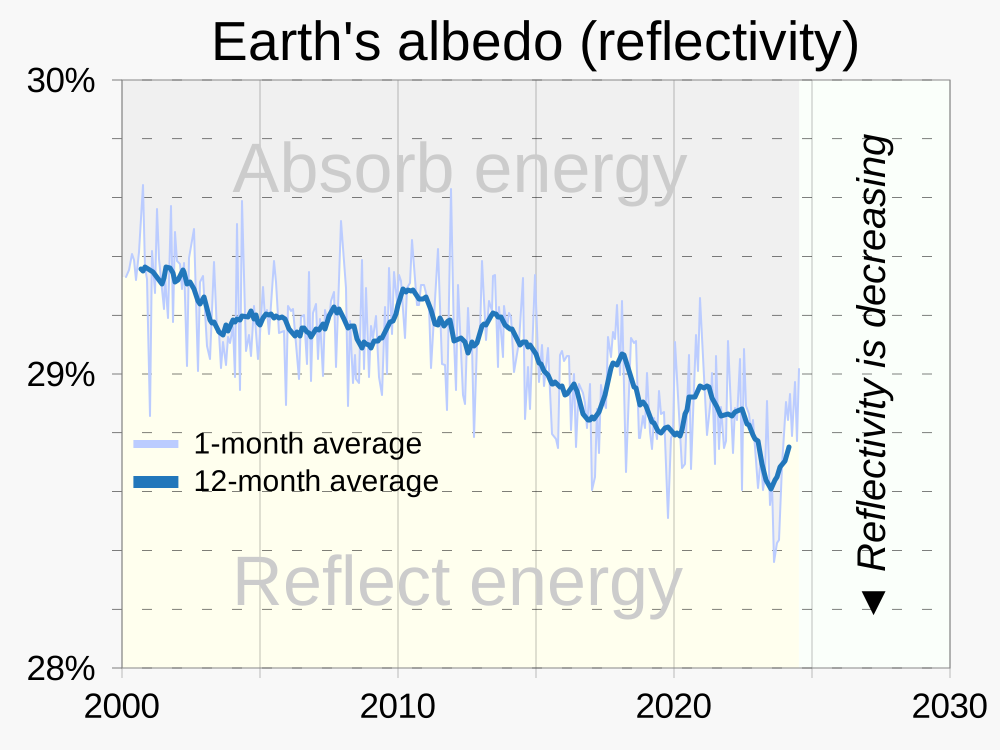
CERES radiation flux measurements of the earth’s incoming and outgoing radiation show a significant decrease in the earth’s reflectivity, a.k.a. albedo, since ~ 2015. Thus, because of conservation of energy, the global mean temperature increased faster. (Plot from Wikipedia.)
_of_Earth.svg)
In this - still not peer reviewed - analysis by Foster and Rahmstorf, the mentioned increase in warming rate was made statistically detectable by removing some temperature noise connected to known mechanisms like solar radiation changes, volcano eruptions and the ENSO.
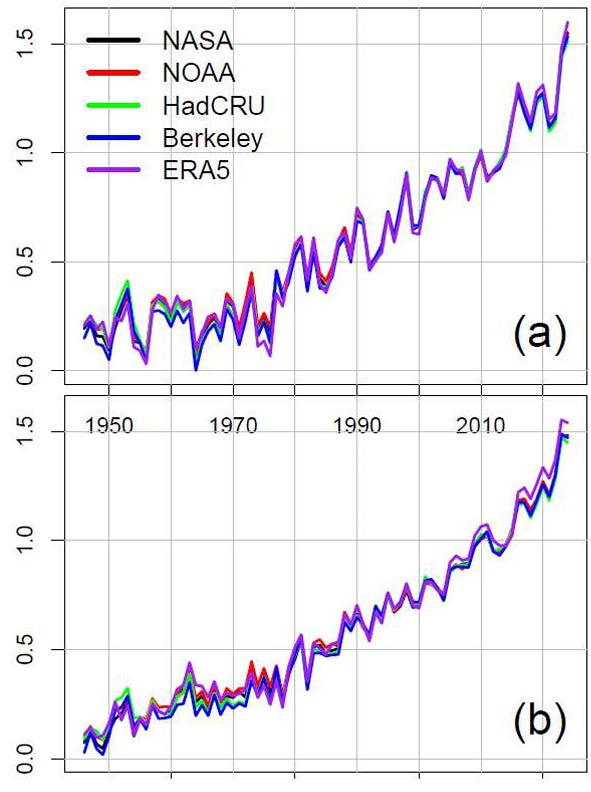
The bottom line is, that the current 10-year warming rate is 0.4 ± 0.1°C/decade, about a doubling of the 1980 - 2010 average rate.
As an outlook, the difficulty for mankind to reduce emissions while experiencing a massive increase in wealth is stressed in this paper:
Sea Level Rise
Average sea level is today pretty precisely measured by satellites.
https://climatechangetracker.org/climate-change-progress/yearly-global-mean-sea-level-rise
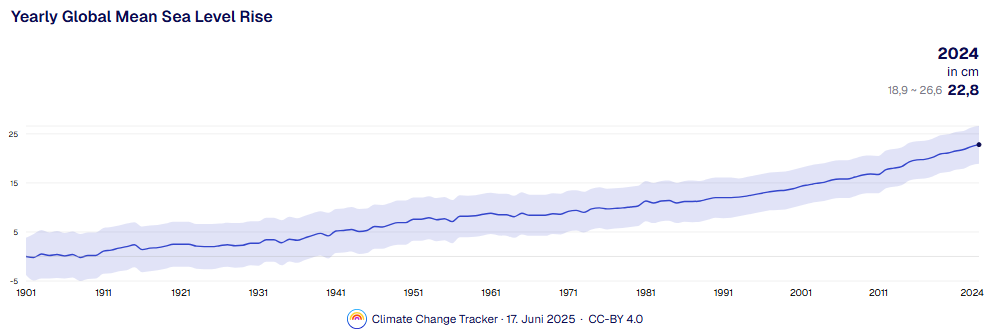
The plot is from this recommendable overview site:
Dashboard for main climate change indicators - climatechangetracker.org
If we look at the year-on-year rise in the period from 1980 to today, we get this (spreadsheet here),
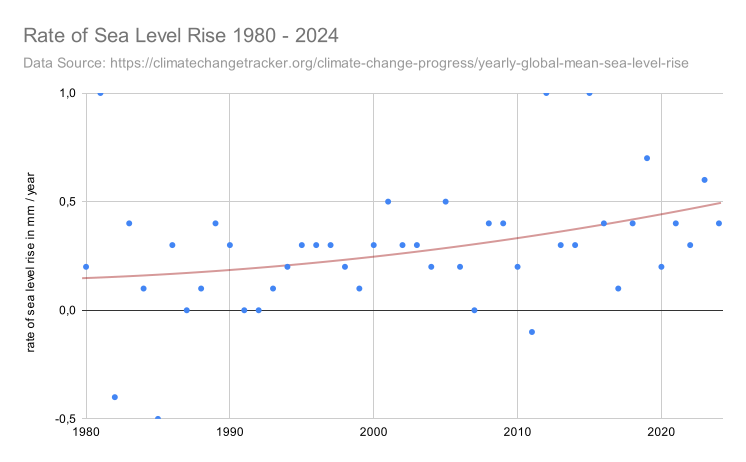
i.e. the rate of SLR is increasing, and might even be slightly accelerating (with the caveat, that the acceleration might not be statistically significant).
Algae Bloom
Bloom of toxic algae in South Australia - no comment to this.
Forests
There are initiatives to promote forest conservation with international financial incentives rather than just relying on common sense. One such initiative is the Tropical Forests Forever Facility (TFFF). Countries receive payments if they deforest less than 0.5% of their land area. However, forest fires in Brazil are dampening the donor countries’ enthusiasm for giving, as less logging is overcompensated by more fires.
Forests taking longer to recover from severe ‘megafires’ since 2010 - Carbon Brief - 05 2025
Fires have become more intense, especially in taiga forests. The land has become drier. Warmth used to be good for the forests, but that has now changed.
They use to occur in the Canadian west, but now burn in central and eastern Canada as well.
Forests are thought to be carbon sinks - but in Germany (and many other places) this is no longer the case. High temperatures and lack of water make them vulnerable to bugs and plant diseases. The recent German Federal Forest Inventory states, that the living biomass in German forests decreased, making them a carbon source. This phenomenon is not confined to Germany:
Amazon rainforest now emitting more CO2 than it absorbs | Amazon rainforest | The Guardian - 07 2021
EU wildfires worst on record as burning season continues | Wildfires | The Guardian - 08 2025
The current state of cumulative burnt area in Europe is from here:
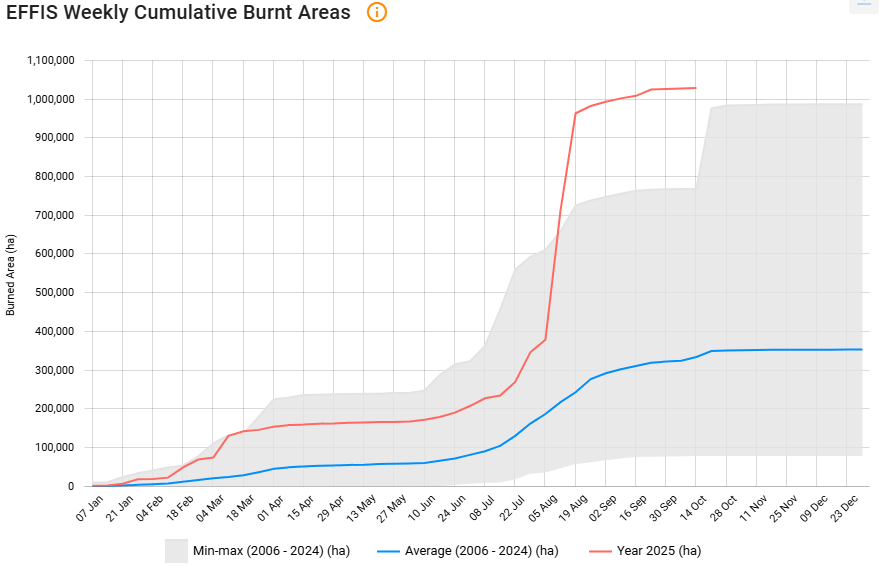
Globally, the situation is less bleak though. We are still below average.
Fresh Water
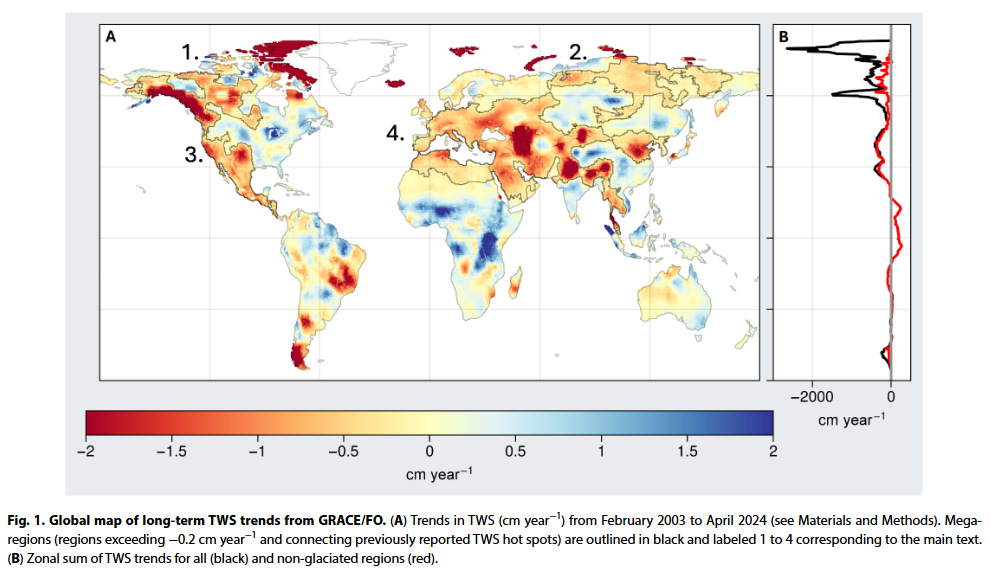
Terrestrial water storage (TWS) means the available water on land: rivers, lakes, soil water, ground water and aquifers. Its change can be mesured by the GRACE satellites, via local changes in the earths gravitational field: if water is lost in a region, the gravitational pull decreases, & v.v. According to this paper, the long term trend shows a redistribution of surface water: a belt from Europe to northern India, with a branch to northern China, is drying, as well as the whole North American west coast. Northern south America, central Africa, most of India and China have been wetting. The underlying trend though is an increase in drier areas.
Food
Global food production is rising, but a couple of regional food price spikes have been linked to preceding climate extremes, i.e. drought or flooding.
Climate extremes, food price spikes, and their wider societal risks - IOPscience:
Agriculture in southern Europe is coming under increasing pressure:
Polar Regions
Microbes able to thrive in ice as it warms make it darker, accelerating ice loss (Guardian).
The Planetary Boundary Concept
As the earth system deviates more and more from its pre-human state, it becomes more and more unstable. The Planetary Boundary Concept tries to assess the state of 9 subsystems with respect to the onset of unstable or in other way detrimental regimes.
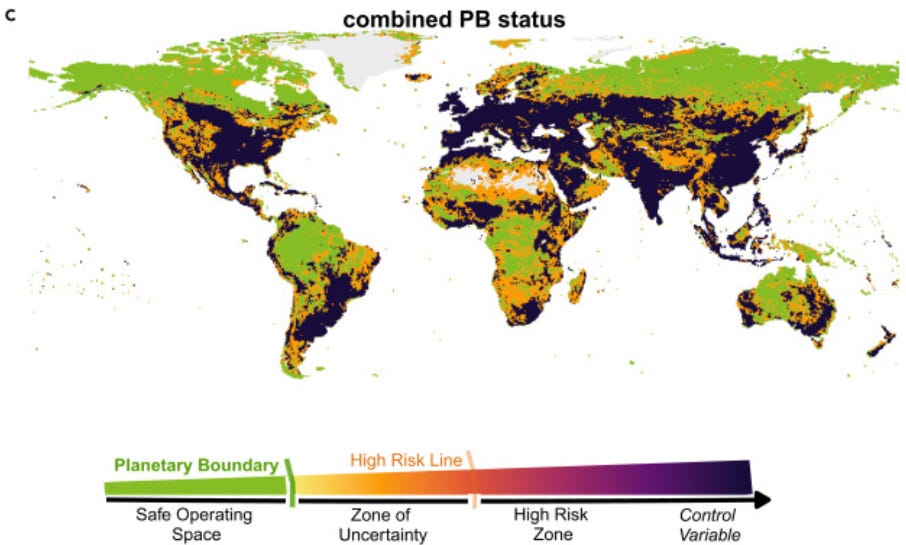
In this paper, the stability of regional ecosystems is quantified by two numbers: the “human appropriated net primary production of the biosphere”, i.e. the share of plant mass extracted and used by humans, and the “EcoRisk” index, deducted from human induced changes in the regional web of chemical substances and reactions and vegetation structure.
If human exploitation in a landscape is too high, the ecosystem degrades. On the map, we see the regions with very high human ecosystem modification:
AMOC
The Atlantic Meridional Overturning Circulation is basically heavy, cold, salty water around Greenland sinking down, thus pushing a deep water current south and pulling a warm water current north. Problem is: as it becomes less and less salty because of more Greenland melt water, it becomes lighter and less water is pulled northward. And the less water is pulled northward, the less heavy salt comes with it, accelerating the dilution by fresh water. If the dilution drive is strong enough, the whole circulation will stop.
Earth system models produce a broad spectrum of results, depending on very small variations in their initial - and boundary conditions. so, even within the same emissions pathway, some models will produce an AMOC shutdown, while others won’t. We use the share of models with AMOC shutdown as a measure of the probability, that it will occur in reality with this emission pathway.
This paper shows, that after 2100, an AMOC shutdown is not only almost certain for high emission scenarios, but has still a significant probability for medium and even for low emission scenarios.
Which means: every ton GHG less, every tenth of a degree less is important.
Renewables, Storage and similar
The German smart meter conundrum:
The country has an astonishingly low smart meter market penetration. This means, that 90% of our households cannot use variable tariffs. In this comment, the slow German way of going for smart meters with biderectional information flow and high cyber security is defended. The grid utility can limit the power flow into and out of the grid to avoid local overload. Thus, the stability of the grid can be guaranteed.
Wind
Last gasp: Securing Europe’s wind industry from dependence on China | ECFR 07 2025
China, with its consistent pro-renewables government strategy, its gigantic home market, its ever-increasing engineering prowess, its varying policies to exclude foreign producers and its still comparatively lower wages is in the process of grabbing the lions share of the global wind power industry. The EU wind turbine manufacturing is still dominant at home, but the writing is on the wall. The page is a well written, detailed assessment of the industry situation. They worked out a list of propositions, from restoring fair competition, creating of local value, create non-chinese supply chains, avoid non-EU control systems and more.
Solar
In case you get into an argument, this webpage might be of use: Factcheck: 16 misleading myths about solar
Geoengineering
We see the reduction of SO₂-based aerosols reducing earths albedo - directly or via the reduction of cloud cover. High altitude injection of SO₂-based aerosols could work - but has its problems. So why not spray sea water into the air to create additional condensation nuclei for additional clouds? Some guys are developing technology for this.
Batteries
New batteries are becoming cheaper by the year, but there is nothing remotely as cheap as used ones, sais this Canary Media take. They won’t become available in numbers before 2035 though.
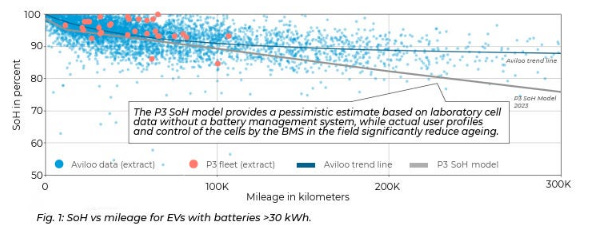
How much do electric car batteries degrade? Hannah Ritchie, science communication lead at Our World in Data, is maintaining a recommendable irregular newsletter on earth system data analysis. Here she found, that car battery capacity degraded in real life even less than in extrapolation from heavy short term tests:
CATL predicting very, very cheap Sodium based batterie (Video by Matt Ferell).
While Na-based batteries are somewhat heavier than Li-based ones, they have a couple of advantages: higher temperature range, low degradation and cheaper carrier ion material. Current total CAPEX for utility scale Li-battery farms is in the range of 150 to several hundred €/kWh_cap. The cell costs are only a 30 - 40% of total system costs. So very cheap cells mean lower - but not proportionally lower - system costs.
Geothermal
The Geothermal Energy Acceleration Act has been drafted by the German government and must now be passed by parliament. While the decarbonization of electricity seems to be under way, heat is another matter. Geothermal can contribute to achieve “Wärmewende” with less need for wind and solar, i.e. less landscape use. If active, the law will shorten permission times considerably.
Carbon Binding
IETA, a commercial emission offsetting association, and UNEP are basically saying: “Let’s allow more fake emission certificates”! Deplorable.
Room heating
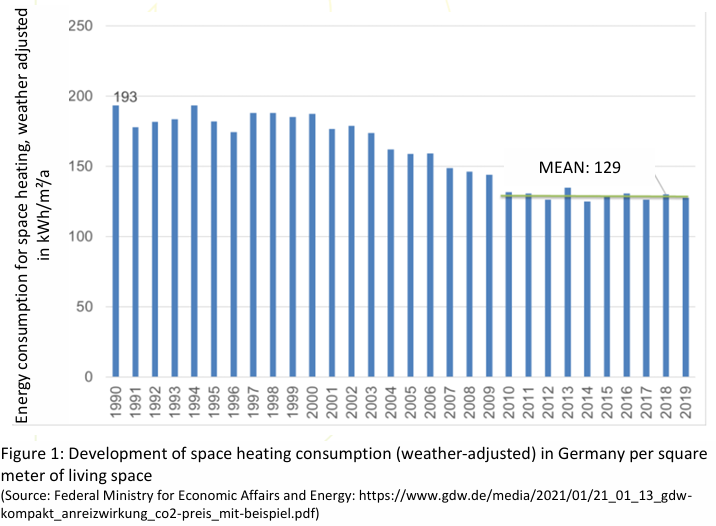
In Germany, a rebound effect has been observed: energy use per m² does not decrease despite better insulated homes. People increased room temperature. Proposition is: heat meters readable by tenants, incentives like point systems, i.e. non-financial motivations to save energy. With EU ETS2, we’ll get a forced emission reduction, so either even more heat insulation, or less emissions per kWh heat supplied, or ppl reducing room temperature again, or a combination of those.
Shipping
In this video on “Engineering with Rosie”, the options for decarbonization of shipping are discussed. TL,DR: Shipping responsible for ~ 3% of current emissions.
There will be much less shipping in a decarbonized world, because transport of fossil fuels will cede to exist, which make up for ~ 40% of bulk cargo shipping today. Also transport of iron and other ore will be replaced by transport of steel and other metals, which have much less mass.
Transport will use less energy (drive slower, improve hull design, prevent fouling by mussels, etc., increase use of wind energy).
For short haul: batteries. Biofuels only small scale because of land use conflict. Electrolytic H2 is a transport- and storage nightmare, so - no. Methanol from air captured carbon and H2 is expensive. Ammonia from air captured Nitrogen and H2 is cheaper, but has a really big security problem.
Energy Storage
Stumbled startup of utility scale storage - klimareporter.de
There are a *lot* of applications for utility scale batteries in Germany, but permission is hampered by
High land costs due to concentration at high power grid entry points.
Illogically high grid fees for both charging and discharging, despite storage actually *reducing* grid load and necessity to upgrade the grid.
Long, non-standardized permission processes.
Politics
The Social Side of Emissions Reduction in Europe
In Germany, natural gas and heating oil have been the main energy sources for heating to date. Due to Russia’s war of aggression, their costs have temporarily skyrocketed. Although they have since become cheaper again, they are not back to their previous levels. In 2027, the ETS 2 (European Emission Trading System 2) will come into effect, reducing total emissions in the building and transport sectors by ~ 5% each year - which is quite ambitious. This continuous shortening of supply will lead to price increases that poorer households will find more difficult to cope with.
China on its way to stricter regulation
China has an emission efficiency trading system, sort of. Inefficient factories or power plants have to buy allowances from more efficient ones. This mechanism does some good, but still allows for absolute increase of emissions - which will change. Starting with 2027, some industries considered as “stable” will get an absolute emissions cap , like in the EU ETS, and 2030, the other industries will follow. A very important development.
China’s carbon market to introduce absolute emissions caps from 2027 | Reuters - 08 2025
Global Right Wing Coordination
The money from Exxon and wealthy US Republicans is used, among other things, to connect right-wing opponents of science and build influence against renewable energies through “institutes” like Heartland. Not good news.
The failed Plastics Agreement
In August, we saw the usual suspect nations torpedo the attempt to create a binding plastics reduction treaty:
To put plastics productions into context: its GHG emission was 2,2 GT, i.e. ~ 5% of global CO2 emissions. Unimpeded, it will rise to 5 - 7 Gt in 2050 - which is of course unacceptable. (Emissions are CO2-equivalent.) (Source)
The plastic treaty has been derailed by the principle of unanimity. The WWF proposed to negociate in a forum where majority decisions can be taken, like the UN general assembly, or to create a treaty between a willing subset of all countries. Also, it designed a programme to improve things in the future:
Ban the most hazardous plastics products and chemicals.
Set up global product design standards for recyclability.
Assistance for less developed countries.
Ensure that the treaty can be further improved.
The Transition in Emerging Countries
Southeast Asia has a lot of coal power. The drying out of western money will lead to more emissions and a larger Chinese influence.
Earth System Protection Before the Courts
As earth system protection is more and more reflected in national and international law and court decisions, governments can now be held accountable for a sluggish approach to decarbonization and bio-system protection. And often, this works! We have a constitutional complaint in Germany, the big ICJ opinion making climate protection a duty - but also a backlash.
Constitutional complaint by BUND, Germanwatch, Greenpeace and others in Germany
Zukunftsklage | Germanwatch e.V. - With weblinks to all relevant legal documents.
International Court of Justice Opinion
The Paris-agreement targets are considered to be legally binding to states, based on principles of international law. Which means, states whith or without suffering of climate damage can sue other states not - or not enough - reducing emissions for cessation, reparation, restitution, compensation and satisfaction.
The Backlash
But pre-climate-crisis trade laws allow for companies to sue governments for allegedly profit-reducing climate action:
Overviews
40 pages of meteorological papers, pretty nerdy.
Dashboard for main climate change indicators - climatechangetracker.org
Very nice neat tiles-based overview of a couple of climate data collections.